
Stainless steel relies on chromium, typically at least 10.5%, to form a protective passive film. Austenite, ferrite and martensite describe crystal structures rather than a single chemical recipe. Composition influences phase stability; cooling, heat treatment and cold working determine which structures are present at room temperature.
1. Microstructure comparison at a glance
| Comparison point | Austenite (γ) | Ferrite (α) | Martensite (α′) |
|---|---|---|---|
| Crystal structure | Face-centred cubic (FCC) | Body-centred cubic (BCC) | Body-centred tetragonal (BCT); distortion depends on carbon content |
| Magnetic response | Usually non-magnetic when solution annealed; cold work can introduce magnetism | Magnetic | Magnetic |
| Strength and toughness | High ductility and toughness; strength can be increased by cold working | Moderate strength; toughness depends on temperature, section size and processing | High hardness after quenching; tempering balances hardness and toughness |
| Corrosion behaviour | Common grades offer good general corrosion resistance; chloride exposure still needs review | Good in suitable environments; generally more resistant to chloride stress corrosion cracking than common austenitic grades | Often lower for common high-carbon grades; chemistry and heat treatment are decisive |
| Quench hardening | No; cold working is a separate strengthening route | No; conventional ferritic grades do not harden by quenching | Yes; normally followed by tempering |
| Phase stability | Ni, Mn and N help stabilise austenite | Cr helps stabilise ferrite | Rapid cooling of suitable austenite can form martensite |
| Typical grades | 304, 316L | 430, 409 | 410, 420, 440C |
2. Understanding the three structures
Austenite: ductility and toughness
Ni, Mn and N can retain the FCC austenitic phase at room temperature. Its many slip systems support forming and high toughness, including at low temperatures for suitable grades. Conventional austenitic stainless steels are strengthened by cold working rather than quench hardening. Nickel content affects cost, and chloride stress corrosion cracking remains a selection concern.
Ferrite: magnetic and not quench-hardenable
Chromium stabilises the BCC ferritic phase. Common ferritic stainless steels contain little or no nickel, can offer useful thermal conductivity and generally resist chloride stress corrosion cracking better than common austenitic grades. They do not harden by conventional quenching; grain growth and a ductile-to-brittle transition can limit toughness.
Martensite: hardness through heat treatment
When a suitable austenitic structure cools rapidly, a diffusionless transformation can trap carbon in a distorted lattice and form martensite. The as-quenched material may be hard and brittle, so tempering is normally required for service. Carbide formation and chromium depletion can reduce corrosion resistance; the result depends on composition and the complete heat-treatment cycle.
3. Four steps for identification
Step 1: Use a magnet only as a first screening tool
Strong attraction can indicate ferritic or martensitic material; little attraction can be consistent with austenitic material. Cold-worked 304 can become magnetic through deformation-induced martensite, and welds can contain ferrite. A magnet cannot authenticate a grade or establish corrosion resistance.
Step 2: Check hardness and the known delivery condition
A substantial hardness increase after an appropriate, controlled quench can support a martensitic classification. Hardness alone is not proof: cold work and previous heat treatment also affect it. Do not quench an unknown finished component as an identification shortcut; use a qualified laboratory when necessary.
Step 3: Verify composition with a suitable method
Ni, Cr, Mn, Mo, C and N together help distinguish families; a single nickel or chromium threshold is not a reliable rule. Handheld XRF can screen many alloying elements but normally cannot measure carbon, so it cannot by itself distinguish carbon-dependent grades or confirm an L grade. Use a suitable carbon-capable method, such as spark OES, and the material certificate where required.
Step 4: Confirm with metallography when needed
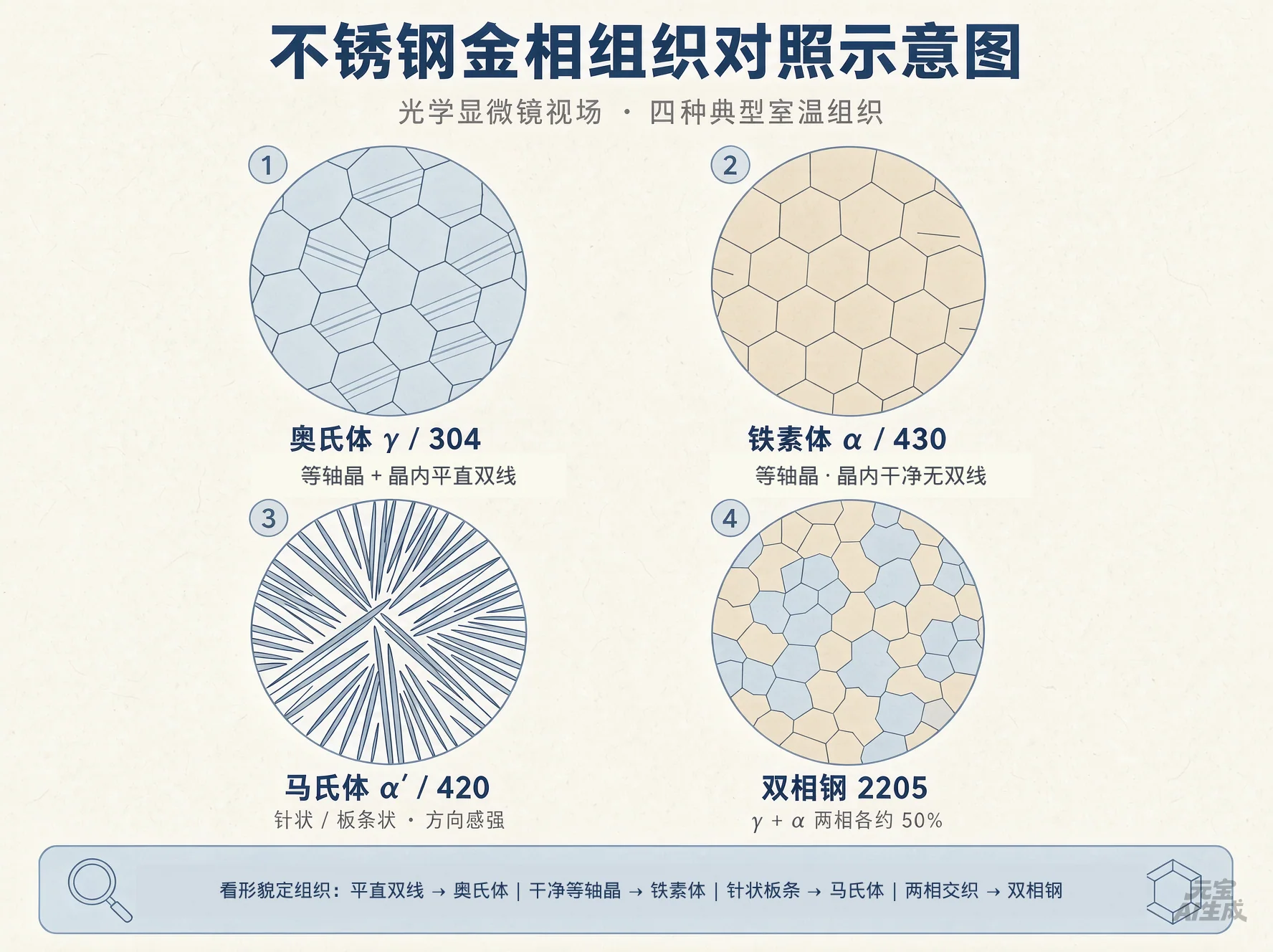
Typical annealed austenite shows equiaxed grains and annealing twins; ferrite often shows equiaxed grains without those twins; martensite can appear as laths or plates. Preparation, etching, processing history and mixed phases affect the appearance. Interpret the micrograph together with chemistry, hardness and delivery records.
4. Three common misconceptions
Non-magnetic does not mean genuine 304. Magnetism reflects structure; corrosion performance also depends on chromium, molybdenum, surface condition and chromium depletion. Confirm the ordered grade using appropriate documents and tests.
Austenitic stainless steel can be strengthened, but not by the conventional quench-hardening route. Cold work can substantially increase yield strength while reducing ductility and sometimes introducing magnetism; the increase is grade- and process-dependent.
Not every stainless steel belongs to just one of these three simple categories. Duplex 2205 combines austenite and ferrite, 17-4PH uses precipitation hardening, and stainless welds may contain delta ferrite. These cases need their own processing and acceptance criteria.
A practical memory aid
Austenitic: typically ductile and tough, with little magnetism in the annealed state. Ferritic: magnetic and not conventionally quench-hardenable. Martensitic: can be hardened by quenching and normally needs tempering. Always qualify this shortcut by grade and delivery condition.
5. Microstructure comparison diagram
6. When to consider duplex 2205
Duplex 2205 is commonly specified as UNS S32205 / 1.4462 / S22053, with nominal 22Cr-5Ni-3Mo-N chemistry. The solution-annealed structure contains both austenite and ferrite and is magnetic. Typical specified yield strength is at least 450 MPa for relevant product standards, often about twice that of 316L; the actual minimum depends on product form, thickness and governing standard. PREN is often around 35, compared with about 24 for 316L, but is only a composition-based screening index, not a corrosion guarantee.
| Selection consideration | Guidance and limits |
|---|---|
| Potential applications | Consider 2205 for selected chloride-bearing water, brine and oilfield service when 316L has insufficient pitting or stress corrosion cracking resistance, or when higher design strength is useful. Seawater performance depends on temperature, oxygen, flow, crevices and deposits; wet chlorine requires a separate specialist corrosion assessment. A possible 30–50% wall-thickness reduction is not a promise: pressure-code design, corrosion allowance, buckling, fabrication and fatigue must be checked. |
| Temperature limits | Long-term service is commonly restricted to around 300°C or below, subject to the code and supplier guidance. Prolonged exposure in ranges such as 600–900°C can precipitate harmful intermetallic phases; damaging transformations are not confined to that range. Use near −40°C requires the specified product and weld toughness to be verified, not assumed. |
| When to use another material | Hot concentrated brine, very high chloride levels and strong acids require corrosion data for the actual concentration and temperature. Superduplex 2507 is one possible candidate, not a universal upgrade for nitric or sulphuric acid. For milder service where 316L meets the requirement, its fabrication and welding convenience may be preferable. |
| Fabrication and welding | 2205 is not conventionally quench-hardenable. ER2209 is a common filler choice. Values such as interpass temperature ≤150°C and heat input 0.5–2.5 kJ/mm are starting references, not a universal welding procedure. Preheat is generally unnecessary except for specific conditions such as moisture removal. Any 1040–1080°C solution treatment followed by rapid cooling, and any ferrite target such as 35–60% or 45–55%, must be justified by the product standard, qualified procedure and acceptance requirements; post-weld heat treatment is not automatically required. |
| Common purchasing pitfalls | 2205 is magnetic because it contains ferrite; lack of magnetism is not an authenticity criterion. Compare verified product price, fabrication cost, allowable section size and life-cycle cost rather than assuming a fixed price ranking against 316L. |
Selection takeaway: keep 316L when it meets the environment, fabrication and design requirements. Consider 2205 when improved chloride resistance or higher strength addresses a defined need, then confirm the full specification, corrosion evidence and qualified fabrication route before substitution.